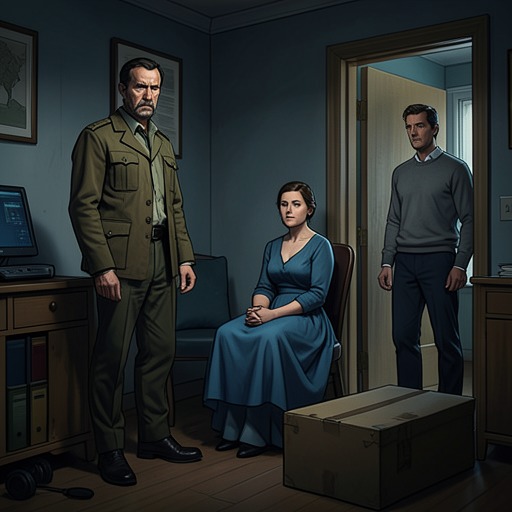
Steef Accidentally Shoots a Man in Utrecht
Nieuwe burenSteef Accidentally Shoots a Man in Utrecht is a defining act of mistaken violence in Steef’s life: believing a man was drawing a weapon, he killed him, only to discover that the object was a mobile phone. The shooting brought his buried wartime trauma to the surface and left him unable to work for months.
The Mistaken Killing and Its Aftermath
Steef recounts the incident as having happened the previous year in Utrecht. He had taken the man for an armed drug dealer and thought he saw him reach for a weapon; it was a mobile phone. Steef describes himself as having completely fallen apart afterward, as everything he had been holding back came out. He could not work for months.
The account emerges when Peter asks whether Steef has ever killed anyone. Steef’s jaw tightens before he answers, and Rebecca strokes his back as he speaks. The gesture accompanies a disclosure that is not presented as a detached report: the killing remains bound to its immediate emotional and bodily aftermath.
Srebrenica and the Return of Threat
Steef places the shooting within a longer history of violence he had never managed to process. He had served in Srebrenica, where a shell exploded near him and he ran through gunfire without initially recognizing the sound of machine guns. The danger felt unreal at the time; only much later, he says, did he understand how close he had come to death and how many thousands of Muslim men had not survived. His account connects the mistaken killing in Utrecht to a past in which threat and survival had already become difficult to comprehend.
That delayed reckoning shapes the force of his appeal to live intensely. Steef urges Peter and the narrator to resist the prisons they have built for themselves, gripping their wrists hard enough to hurt. He then turns to music, calling U2 his salvation and saying it works better for him than therapy. The movement from traumatic memory to physical insistence and then to music presents survival not as a resolved condition but as something he has to keep demanding of himself and others.
The past also returns as an immediate misreading of danger. In a later episode, Steef believes that men are still pursuing him, even in the place where he has taken refuge. The narrator begins to understand what is happening and tries to establish that nobody has come out through the visible door, while also recognizing the need to become sober. The scene echoes the earlier confusion between an apparent weapon and a phone: in both, Steef experiences a threat as present before the evidence can correct it.
The book distinguishes the killing from the later official action against Steef. He says he has not been suspended because of the young man’s death: the police have no evidence against him, but have suspended him because photographs found at the young man’s home make him vulnerable to blackmail. That distinction leaves the shooting’s aftermath unresolved in a different way: the account establishes its personal cost, while the suspension rests on separate compromising material.
The Technique Repeated at the Firing Range
Steef later guides Peter through firing a handgun, standing close behind him and correcting the way he extends his arm. He had taught Eva in the same manner. As Steef urges him to focus on an enemy, Peter sees only the target’s dot, braces himself, and fires; the shot flies well above it. The lesson makes the handling of a gun both practical and intimate, while Peter’s thought that he could turn and shoot Steef exposes the threat underlying their closeness. In light of Steef’s account of mistaking a mobile phone for a weapon in Utrecht, the scene also sets deliberate instruction against fatal misrecognition: here Peter cannot even make the imagined enemy coincide with the target.
Responsibility and the Limits of Explanation
The account keeps two questions apart: what Steef did in Utrecht and why the police later suspended him. The suspension is not presented as a finding about the killing; the material found at the young man’s home creates a separate vulnerability, while the shooting itself remains part of Steef’s disclosed past. That separation prevents either personal collapse or official suspicion from serving as a simple verdict. His explanation makes the fatal misreading intelligible within a history of violence, but does not undo its consequence: a man is dead, and the account offers no further resolution.